
Why family promises should not stay at the kitchen table
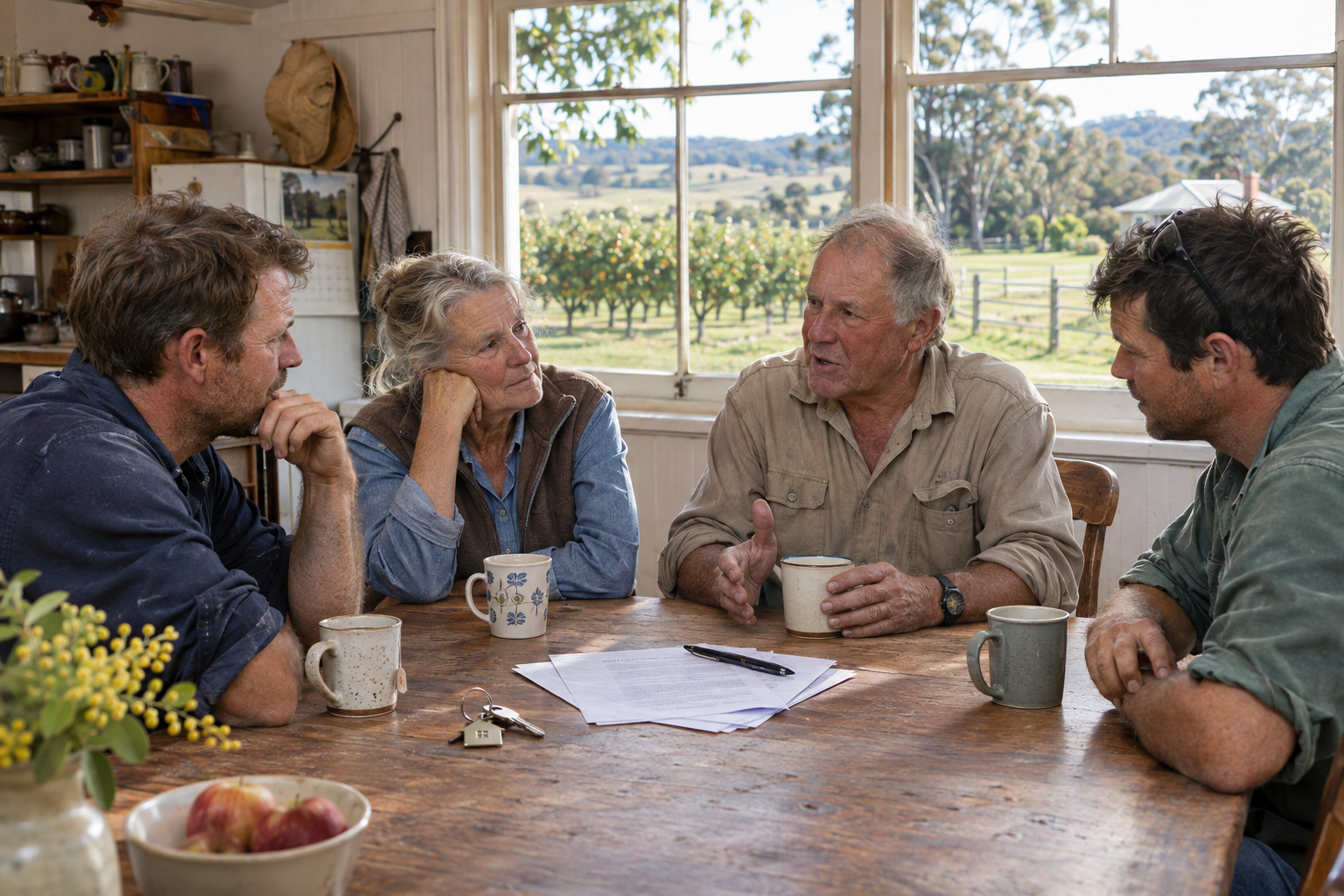
The appeal decision of Pirrottina v Pirrottina demonstrates the importance of succession planning and recording promises made or agreements in writing, so there is less room for dispute if family relationships later break down and oral agreements aren't honoured.
In some circumstances, a promise may be treated as legally binding even if it was not recorded in a formal contract. This can happen through a legal principle called estoppel.
There are different types of estoppel. This case involved proprietary estoppel, which is a form of estoppel concerning real property. Broadly, proprietary estoppel may arise where:
one person (Person A) promises or assures another person (Person B) to believe they have, or will receive, rights in land;
Person B relies on that promise and the reliance is reasonable;
Person B would suffer a disadvantage if the promise was not honoured; and
it would be unfair, or unconscionable, for Person A to go back on the promise.
If those matters are established, the Court may make orders to prevent Person A from backing out of their promise to Person B. This may include a declaration that Person B is the legal owner of all or part of land.
In Pirrottina, the Court made orders requiring a third party to uphold the terms of the promise made to a person.
The facts
Pirrottina concerned a family farm owned by Mr and Mrs Pirrotina. They had two sons, Sam and Rocco. Sam and Rocco began working on the farm at a young age (13 and 14 respectively) and did so for no wages.
In 1994, when Sam was 26 years old, his parents promised him that they give him a defined area of land on the farm between a driveway and an orchard and that they would build him a house on that lot. The following day, Sam told Rocco of the conversation with his parents about the promised lot. In that same year and the years following, the family had discussions around the dining table in which Sam spoke about building his family home on the farm.
In 1995, a home was built on the lot and in late 1996, the parents gave Sam and his new wife Marisa the keys and told them to move into their new house (and they did).
Sam relied on his parents' assurance that the lot was his in that:
declined his parents’ offer to buy him another block of land on which to build his house. The parents had provided similar assistance to Rocco, helping him buy a farm in Kulnara;
he moved into the house and lived there, making it his home (including conducting renovations and improvements) and continuing to work in the family business at a level of remuneration below the market rate;
Sam also accepted a gift from his father-in-law to construct the driveway and pathways, together with landscaping works, on the lot.
During this time, Rocco lived in the family home at the farm within eyesight of Sam's house.
In 2002, the parents transferred the farm to Sam and Rocco on the express basis that Sam and Rocco would run the family business as partners; they would not sell the farm and that the parents would maintain control over the land, its improvements and buildings (including Sam's house).
Following this, Sam and Rocco owned the farm as tenants in common in equal shares. Sam and Rocco operated under a partnership, the farming business, both on the family farm and Rocco's farm at Kulnura (the Kulnara Farm).
In 2018, after Sam and Rocco's dad passed away. Following this, Sam and Rocco's working relationship soured.
In 2020, Sam and Rocco had a meeting to address concerns with the partnership. During that meeting, which was attended by others including their mother, their mother made statements to the effect that the home Sam built on the farm belongs to Sam.
The Court proceedings
Rocco commenced proceedings against Sam seeking orders to dissolve the partnership. Relevantly, Rocco sought that the partnership property included the farm (including the lot promised to Sam).
Sam argued that he had an equitable interest in the lot under the principle of estoppel on the basis that:
his parents made representations in 1994 and 1996 to him that the lot was his;
he suffered detriment, including losing the opportunity for his parents to buy him a block of land, losing employment opportunities that he did not pursue because he relied on his parents’ representations, losing income, and losing the opportunity to receive an alternative gift from his father-in-law.
he would suffer detriment if there was a departure from the assumption he made in reliance on the representations (that the lot was his).
Rocco argued, amongst other things, that any promise made by the parents was "too vague" to give rise to any equitable rights and any reliance by Sam was not reasonable.
At first instance the trial judge found in Sam's favour. Rocco then sought to appeal on several bases, including arguing the trial judge erred in finding that there was reliance and detriment. One of the arguments that he made was that Sam's reliance on the promise for the parents to give him the lot was not reasonable because the promise was "replaced" by a gift of half of the farm in 2002 and from that point, Sam's belief that the lot was his was a delusion and his continued occupation of the Lot depended on his relationship with Rocco.
Rocco's appeal failed. He was ordered to sell his interest in the farm to Sam at market value. The Court of Appeal relevantly stated that Rocco's argument ignored the fact that Sam relied on the promise made by the parents before the property was transferred in 2002. That reliance did not change with the 2002 transfer and there was no suggestion that the parents sought to interfere with Sam's interest in the Lot or his house by reason of transferring the farm to their sons in 2002.
What can we learn from this matter?
It is always recommended to obtain legal advice for any type of succession planning (whether it be business related or personal) to ensure that the correct documentation is put in place and any required steps are taken.
In this case, it may or may not have assisted Sam to subdivide the land so as to separate out his home from the farm. It is always recommended to obtain legal advice before doing so as this may give rise to tax implications (particularly where the land or part of the land is being used for income producing purposes).
Record any agreement in writing. It may have assisted Sam and prevented this dispute if:
the parents had put their intentions regarding the property in writing (particularly prior to the transfer in 2002) and Sam and Rocco had signed it; or
Sam, Rocco and their parents had entered into a written agreement recording the terms of the transfer (including recognition of Sam's house) in 2002.
Whether or not an agreement is binding is another question.
The material in this article was correct at the time of publication and has been prepared for information purposes only. It should not be taken to be specific advice or be used in decision-making. All readers are advised to undertake their own research or to seek professional advice to keep abreast of any reforms and developments in the law. Brown Wright Stein Lawyers excludes all liability relating to relying on the information and ideas contained in this article.
contact

Chris Wilkinson
Partner
E cdw@bwslawyers.com.au
P 02 9394 1036

Gillian Tam
Senior Associate
E ekg@bwslawyers.com.au
P 02 9394 1046