
Updates to Australia’s New Merger Control Regime

On 18 December 2025, the Government released significant amendments to the new merger control regime through the Competition and Consumer (Notification of Acquisitions) Amendment (20205 Measures No.1) Determination 2025 (Determination). These changes affect when businesses must notify the ACCC of acquisitions and introduce a range of new exemptions and updated thresholds under the new merger control regime which came into force on 1 January 2026, with some changes commencing on 1 April 2026.
For more information about the new merger control regime see our article here.
Key updates
The Determination has introduced several key updates to the regime including:
new and expanded exemptions;
additional notification requirements for share acquisitions that result in certain increases in voting power;
clearer guidelines for applying for a notification waiver; and
changes to when one entity will be 'connected' to another entity.
Updated exemptions
Several exemptions have either been introduced or expanded including:
acquisitions of land or interests in land made in the ordinary course of business;
progressive land acquisitions where earlier acquisitions were waived or notified;
clarifications to the connected entity test for special purpose vehicles which affects whether thresholds are met;
acquisitions made through financial‑market instruments, such as derivatives, foreign‑exchange contracts and other financial securities;
acquisitions made under debt and security instruments;
acquisitions involving superannuation entities;
acquisitions involving entities under external administration;
certain acquisitions connected with regulated market infrastructure (e.g. clearing/settlement facilities);
acquisitions by nominees, custodians and other trustees; and
acquisitions that occur by operation of law.
Voting Power
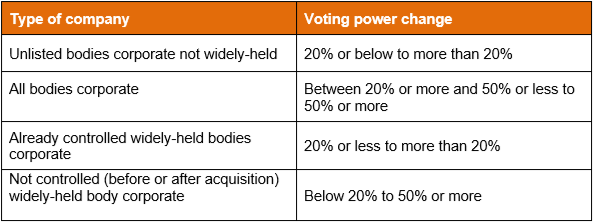
Under the new regime, an acquisition of shares that does not result in the acquirer gaining control of the target company is generally not notifiable. However, from 1 April 2026, the Determination introduces an exception requiring notification where certain increases in voting power occur, even where control is not acquired.
Set out below is a summary of instances where a change in voting power will require notification under the merger control regime:
Amended thresholds for asset acquisitions
The regime now distinguishes between:
asset acquisitions which involve all or substantially all the assets of a business; and
asset acquisitions which do not involve all or substantially all the assets of a business (Discrete Asset Acquisitions).
At a high level, the table below outlines the monetary thresholds that are required to be satisfied for a notification obligation to arise:
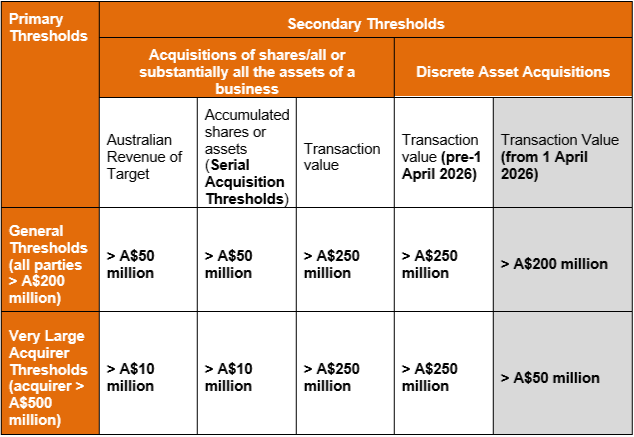
As outlined in the table above, if the following thresholds are met, a notification obligation can arise if:
the acquirer (and connected entities) and the target (and connected entities) have a combined Australian annual turnover of at least $200 million, and either:
the target (and connected entities) has an Australian annual turnover of at least $50 million; or
the transaction is worth at least $250 million; or
the acquirer (and connected entities) has an Australian annual turnover of at least $500 million and buys a target (which together with connected entities) has an Australian annual turnover of at least $10 million; or
for serial or creeping acquisitions in the previous 3 years:
the acquirer (and connected entities) and the target (and connected entities) have combined Australian annual turnover of at least $200 million and the cumulative turnover from acquisitions supplying the same goods or services in the last 3 years is at least $50 million; or
the acquirer (and connected entities) has an Australian annual turnover of at least $500 million and the cumulative turnover from acquisitions supplying the same goods or services in the last 3 years is at least $10 million.
From 1 April 2026, the following monetary thresholds will apply for Discrete Asset Acquisitions:
the acquirer (and connected entities) and the target (and connected entities) have combined Australian annual turnover of at least $200 million, and the greater of:
the market value of the acquisition; or
consideration received or receivable for the acquisition, is $200 million or more; or
the acquirer (and connected entities) has an Australian annual turnover of at least $500 million, and the greater of:
the market value of the acquisition; or
consideration received or receivable, is $50 million or more.
What businesses need to do now
Previously, businesses could rely on their own self-assessment as to whether their transaction impacted competition and whether to seek ACCC clearance.
The new regime now requires upfront disclosure and approval (or waiver) by the ACCC before a transaction can be completed.
Businesses now must:
Budget for fees and timing: These new requirements add cost and complexity - build both into your deal schedule.
Watch cumulative deals: Serial acquisitions could now fall within the thresholds under the creeping acquisition rules.
Engage early with the ACCC: Pre-lodgment discussions with the ACCC may reduce uncertainty for complex or time-sensitive transactions.
Update deal documents: Consider adding conditions precedent and risk allocation provisions specifically tied to mandatory notification and clearance under the new regime.
Manage public disclosure: Prepare non-confidential summaries carefully as details will appear on the ACCC’s Merger Register.
How we can help
The new merger control regime has fundamentally changed how deals are executed in Australia. Early planning is essential to avoid costly delays or disruptions in your transaction.
Contact our Commercial team to discuss how these changes could affect your transaction strategy and what steps you can take now.
The material in this article was correct at the time of publication and has been prepared for information purposes only. It should not be taken to be specific advice or be used in decision-making. All readers are advised to undertake their own research or to seek professional advice to keep abreast of any reforms and developments in the law. Brown Wright Stein Lawyers excludes all liability relating to relying on the information and ideas contained in this article.
contact

Amanda Comelli
Partner
E akc@bwslawyers.com.au
P 02 9394 1044

Suzanne Howari
Senior Associate
E sxh@bwslawyers.com.au
P 02 9394 1072